Sediment, Rust, and Lukewarm Showers: Fall Water Heater Maintenance for Southern Tier Homes
LouAnn Sheldon September 18, 2026 7 min read
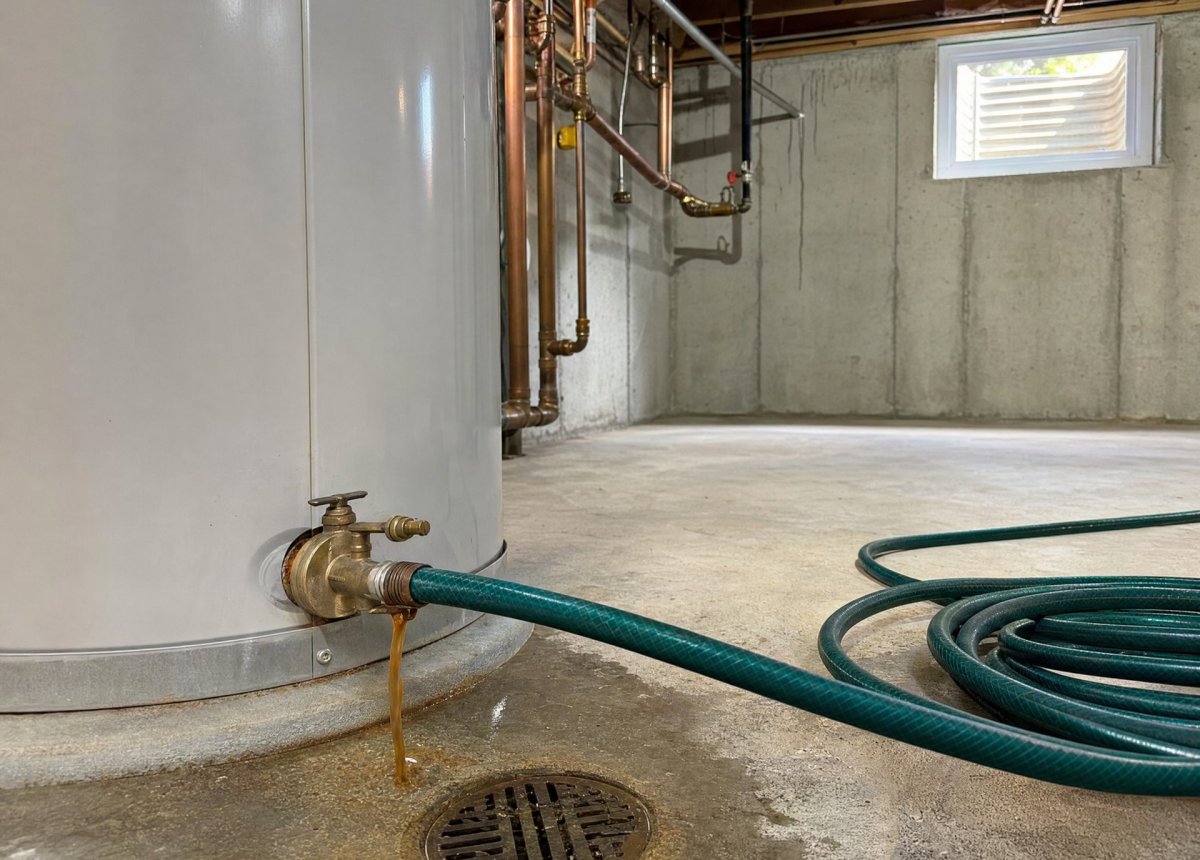
Water heaters are the most reliably ignored appliance in the house. They sit in a basement corner doing their job for a decade and then fail on a Tuesday morning with four people trying to get out the door.
Most homeowners only think about the tank when it’s time to replace it, which skips the part that matters: a water heater that gets an hour of attention each fall commonly lasts several years longer than one that doesn’t. For a household trying to postpone a major expense, that’s real money.
It matters more here than most places, because the water in the Southern Tier is hard. Action Plumbing, Heating, and Cooling has serviced water heaters across Greater Binghamton since 2006, and sediment is the most common reason we see tanks fail early.
Why Hard Water Is Hard on Your Tank
Hard water carries dissolved calcium and magnesium. When it is heated, those minerals come out of solution and settle to the bottom of the tank as a gritty layer of sediment.
On a gas water heater the burner sits underneath that layer, so it runs longer to reach the same temperature and the bottom of the tank gets hotter than designed. That accelerates corrosion and can crack the glass lining. On an electric unit, sediment buries the lower heating element until it burns out.
Symptoms show up before failure does. Popping or rumbling during a heating cycle is water boiling underneath sediment, and less hot water than you used to get means sediment is occupying volume the tank needs. Our post on what hard water does to plumbing in the Southern Tier explains the broader damage it causes throughout the house.
How to Flush the Tank
This is a genuine homeowner job on most units. Set aside an hour and grab a garden hose.
- Cut the heat. Turn a gas unit’s control to pilot or vacation. For an electric unit, shut the breaker off, since energizing an element in an empty tank destroys it in seconds.
- Let it cool. Give it a couple of hours, or plan the job for a morning before anyone has showered.
- Connect a hose to the drain valve at the base of the tank and run it to a floor drain or outside.
- Shut the cold supply valve on top of the tank, then open a hot faucet somewhere in the house to break the vacuum.
- Open the drain valve and let the tank empty. Expect discolored water and grit at first.
- Rinse. With the drain open, briefly reopen the cold supply to stir up what’s left. Repeat until the water runs clear.
- Close the drain, refill, and restore power only after the tank is completely full. Run a hot faucet until the air is out of the line.
Once a year is right for most homes here. If the drain valve is corroded shut or the outflow stays cloudy no matter how long you rinse, stop and call us. Forcing a seized plastic drain valve is how a maintenance task becomes an emergency.
The Other Three Things to Check
These take another fifteen minutes and catch most of what goes wrong.
- The anode rod. This sacrificial rod corrodes so your tank doesn’t. Hard water consumes them faster, and once it’s gone the tank itself starts rusting. Replacing a spent rod is inexpensive and the single most effective way to extend tank life.
- The temperature and pressure relief valve. Lift the lever briefly, confirm water discharges, then confirm it stops. This is the safety device that keeps a tank from becoming dangerous, and it should never go untested.
- The expansion tank, if your system has one. Tap it. A hollow sound on top and solid on the bottom is correct. A tank that feels uniformly heavy has lost its charge and is no longer absorbing thermal expansion. Amtrol expansion tanks and well system products are what we most often install for this.
Check your temperature setting too. 120 degrees is the standard recommendation, hot enough for a household and cool enough to reduce scalding risk and slow mineral buildup.
When Maintenance Isn’t Enough
Flushing buys years off a healthy unit. It doesn’t reverse damage already done. Call us if you see any of the following:
- Rusty hot water at every fixture, which suggests the tank lining has failed
- Any water on the floor around the base, which is usually terminal on a tank
- Hot water that runs out noticeably faster than it did last year
- A unit over ten years old showing corrosion at the fittings
Our guide to knowing when it’s time to replace your water heater walks through that decision. If replacement is where you land, our water heater replacement and repair service covers conventional tanks, and tankless water heater installation suits households that run out of hot water regularly. Our comparison of tankless versus traditional water heaters lays out the tradeoffs honestly.
Treating the Cause, Not the Symptom
If you’re flushing heavy sediment every year, the water itself is the issue. A softener or conditioning system protects the water heater, dishwasher, washing machine, and every fixture in the house at once.
That’s a bigger conversation than a fall checklist, and our posts on water treatment solutions in the Southern Tier and what’s really in your tap water are the place to start. Softening usually pays for itself across all the appliances it protects rather than through any one of them.
An Hour Now, Years Later
Put it on the same weekend as the furnace filter and the smoke detector batteries. Flush the tank, check the anode rod, test the relief valve, confirm the temperature. That’s the whole list.
If any of that is more than you want to take on, we’re glad to handle it. We’re a family owned company serving Johnson City and the surrounding Southern Tier communities since 2006, with fair pricing and technicians who clean up after themselves. See our customer reviews or our full range of Binghamton plumbing services.
Call (607) 205-1177 or request an estimate online, and we’ll make sure you head into winter with hot water you can count on.